Chemical Engineering Mock Interview 2
Mock interview questions covering dimensional analysis, mathematical functions, and biotechnology applications
7 questions • Estimated time: 45-60 minutes
How to Use This Mock
- Read each question carefully
- Attempt your own answer first — spend at least 5 minutes thinking
- Only reveal the model answer after you've tried
- Compare your reasoning to the model answer
Some physical phenomena are extremely challenging to model, but we can get a long way using dimensional analysis. This is the idea that if an equation exists it must also exist in a dimensionless form. This can dramatically reduce the number of variables that need to be considered.
Spherical pharmaceutical pellets discharge from a circular orifice of diameter at the base of a cylindrical bunker. A steady gauge pressure is applied by air at the top of the bunker, resulting in a mass flowrate of pellets.
The flowrate depends on: bulk density of pellets , pellet diameter , orifice diameter , applied pressure , and gravitational acceleration .
Part (a): First, let's identify what dimensions each of these quantities has. Can you write down the dimensions of , , , , , and ?
Model Answer
Mass flowrate has dimensions of mass per time, so . Density is . Both diameters are lengths: . Pressure is force per area, so . Gravity is .
Part (b): We have 6 variables and 3 dimensions, so we expect dimensionless groups. There are lots of ways you can do this, but today let's look for three groups based on , and . How would you construct these?
Model Answer
Initial hypothesis:
We could combine variables to cancel out dimensions?
Possible Approach:
so , ,
Part (d): Now express your result as a relationship for in terms of the other variables and an unknown function.
Model Answer
Initial hypothesis:
The dimensionless groups must be related somehow?
Interviewer Nudge:
Yes. Dimensional analysis tells us that must be some function of and . Write this out.
Final answer:
Interviewer conclusion:
Perfect. Notice how dimensional analysis reduced our problem from 6 variables to just 2 dimensionless parameters. The exact form of would need to be determined experimentally or from detailed modeling.
Sketch the function .
Model Answer
This is one of those questions you just need to know. The exponential part is called an envelope and this stretches the amplitude of to touch the functions and . All of the turning points and zero crossings are unchanged in .
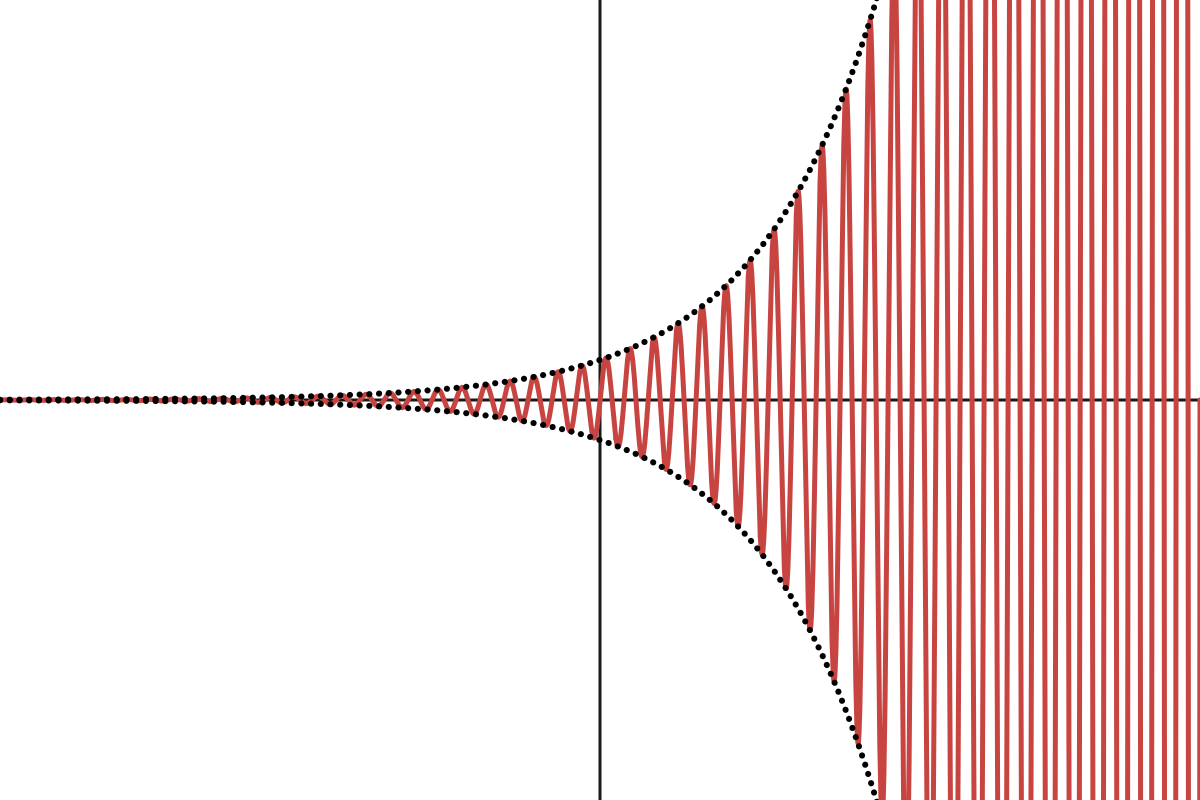
Click to enlarge
One proposal for addressing climate change is to use algae to capture CO₂ from the atmosphere through photosynthesis.
Part (a): What raw materials would the algae need to grow and capture carbon?
Model Answer
Initial hypothesis:
They'd need CO₂ from the air and sunlight for photosynthesis.
Interviewer Nudge:
Yes, those are key. What else? Think about what plants need to grow.
Refined response:
They'd also need water, and nutrients like nitrogen and phosphorus—similar to fertilizers used in agriculture.
Interviewer follow-up:
Exactly. So we'd need: CO₂, sunlight, water, nitrogen, and phosphorus. Keep these in mind for the next parts.
Part (b): Could this algae-based approach be scaled up to make a meaningful impact on atmospheric CO₂? What practical challenges might arise?
Model Answer
Initial hypothesis:
If algae grow quickly, maybe we could just grow lots of them in ponds?
Interviewer Nudge:
Let's think about scale. Global CO₂ emissions are about 40 billion tonnes per year. Even if algae are efficient, what resource might become limiting?
Refined response:
We'd need enormous amounts of water and land. And the nutrients—especially phosphorus—would be a problem. Phosphorus is mined and it's a finite resource. At global scale, we might run out.
Interviewer follow-up:
Good thinking. Also consider: atmospheric CO₂ concentration is about 420 ppm—quite dilute. What does this mean for efficiency?
Final thoughts:
The algae would need to extract CO₂ from very dilute air, which is slow. Maybe it's better to capture CO₂ from concentrated sources like power plant exhaust instead of directly from the atmosphere.
Part (c): What could go wrong ecologically? And how might you make this economically viable rather than just an expensive carbon removal technology?
Model Answer
Initial hypothesis:
Maybe the algae could escape and cause problems in rivers or oceans?
Interviewer Nudge:
Yes, good point. What specific problems might they cause? Think about ecosystems.
Refined response:
If genetically modified algae escape into natural waters, they might outcompete native species and disrupt the food chain. We'd probably need closed systems—like bioreactors—to contain them, but that's more expensive.
Interviewer follow-up:
Exactly. Now, the algae biomass itself—once you've grown it, what could you do with it to generate revenue?
Final thoughts:
The algae could be processed into useful products: biofuels for energy, animal feed for livestock, or even specialty chemicals. If we can sell these co-products, it helps offset the cost. We might also get carbon credits. But we'd need to check that the energy used for harvesting and processing doesn't exceed the value created.